Research in Brief

94

Between God, the People, and the State: Citizen Conceptions of Zakat

This publication is also available in French

Between God, the People, and the State: Citizen Conceptions of Zakat

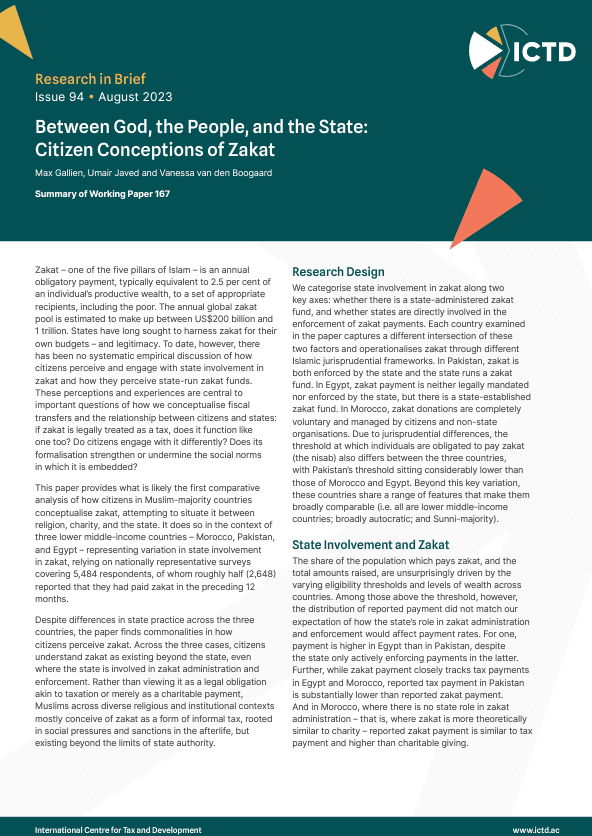
Zakat – one of the five pillars of Islam – is an annual obligatory payment, typically equivalent to 2.5 per cent of an individual’s productive wealth, to a set of appropriate recipients, including the poor. The annual global zakat pool is estimated to make up between US$200 billion and 1 trillion. States have long sought to harness zakat for their own budgets – and legitimacy. To date, however, there has been no systematic empirical discussion of how citizens perceive and engage with state involvement in zakat and how they perceive state-run zakat funds. These perceptions and experiences are central to important questions of how we conceptualise fiscal transfers and the relationship between citizens and states: if zakat is legally treated as a tax, does it function like one too? Do citizens engage with it differently? Does its formalisation strengthen or undermine the social norms in which it is embedded? Summary of Working Paper 167.

Publication Details

Date

Publisher

Share

Citation

Gallien, M.; Javed, U. and van den Boogaard, V. (2023) Between God, the People, and the State: Citizen Conceptions of Zakat, ICTD Research in Brief 94, Brighton: Institute of Development Studies, DOI: 10.19088/ICTD.2023.041

More resources

Authors

Related Publications

Journal Article

Zakat, Non-state Welfare Provision and Redistribution in Times of Crisis: Evidence from the Covid-19 Pandemic

October 2024
Max Gallien, Umair Javed, Vanessa van den Boogaard

Working Paper

Zakat as Non-State Social Welfare Provision: Distributional Dynamics and Gender Equity in Pakistan

January 2026
Max Gallien, Umair Javed, Vanessa van den Boogaard

Factsheet

Zakat Payments in Pakistan Exceed State Social Protection

March 2025
Max Gallien, Umair Javed, Vanessa van den Boogaard

Book

Taxation and State-Building in Developing Countries: Capacity and Consent

January 2008
Deborah Brautigam, Odd-Helge Fjeldstad, Mick Moore