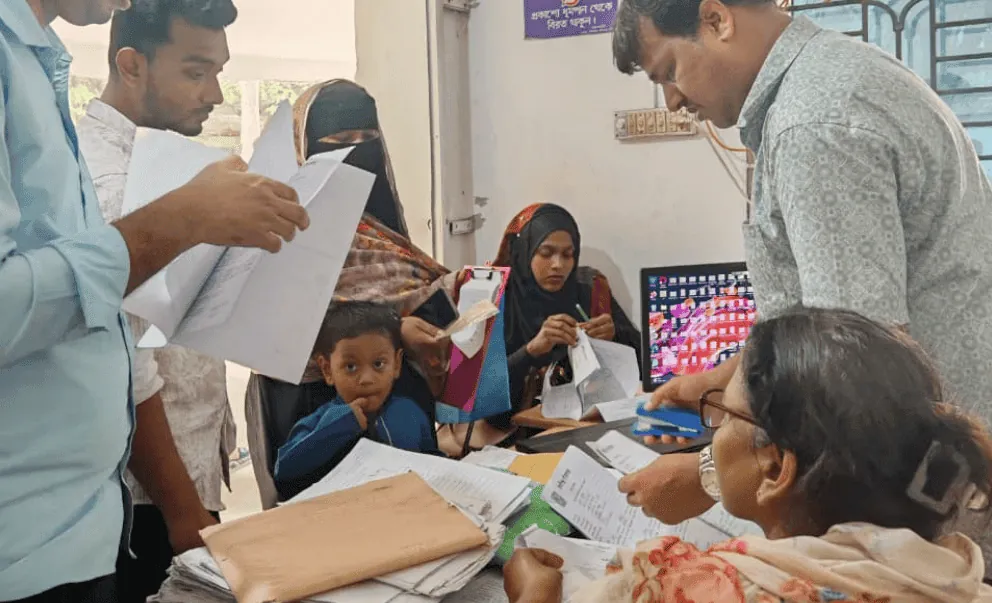






Bangladesh has begun work on AI-powered Digital Public Infrastructure (DPI) which it aims to launch within 18 to 24 months, according to the Prime Minister’s Adviser on Telecommunications and ICT speaking in New York last week. Key to its implementation will be a central digital ID as the main means of accessing various government services. Digital inclusion, however, depends on the human and institutional arrangements that make such online systems usable. Currently, digital centres in Bangladesh can be powerful bridges between analogue citizens and the digital state, but only where the bridge is strong enough on both sides.
Growing government interest and investment in Digital Public Infrastructure (DPI)
With governments around the world increasingly investing in Digital Public Infrastructure (DPI), more and more public services are moving online: identity records, certificates, tax payments, social protection applications, land documents, and local licences. This promises faster, cleaner and more transparent administration. Yet, it also creates a new problem: what happens to citizens who still live largely ‘analogue’ lives, without reliable internet, strong digital skills, or the confidence to navigate official platforms?
Across South Asia, the expansion of digital and AI-enabled public services is raising a similar question: who carries the practical burden of making these systems work for ordinary people?
Technological momentum needs to be matched with evidence, ethics, sustainability, and close attention to what innovation costs frontline workers. The same concern runs through our work on Bangladesh’s digital centres: DPI is only as inclusive as the human and institutional arrangements that help people use it.
These linked questions are at the centre of our joint Institute of Development Studies (IDS) and BRAC Institute of Governance and Development (BIGD) research project, funded by the International Centre for Tax and Development (ICTD).
We are studying Bangladesh’s Union Digital Centres (UDCs) and Pourashava Digital Centres (PDCs): physical service points intended to help citizens access an increasingly digital state. Our fieldwork focuses on two contrasting districts: Gazipur, a relatively wealthier district close to Dhaka, and Gaibandha, a poorer and more distant district in the north. Across these sites, we ask when digital centres help citizens cross into the digital state and when they simply become another layer in a complicated bureaucracy.
One-stop shops as physical bridges to a digital state
Bangladesh has been heavily investing in digital government for the past 15 years.
Many services that were once handwritten, paper-based or handled through local offices now involve online portals, digital records, scanned documents, databases and software platforms. For citizens with smartphones, technological self-confidence and good information, this may be manageable. For many others, especially older people, rural residents, poorer households, women with limited mobility, or people with low literacy, digitalisation can make public services harder to reach.
This is where digital centres matter.
UDCs are located at Union Parishads, the lowest tier of rural local government, whereas PDCs operate in municipalities, or Pourashavas. In principle, both are meant to work as one-stop access points: places where citizens can apply for certificates (birth, death, citizenship), inheritance documents, trade licences, social protection schemes and other services without having to navigate the digital system alone.
At their best, these centres do two things at once:
- Physically improve access by bringing services closer to citizens who would otherwise have to travel further, often repeatedly, to government offices.
- Simplify administration by translating official procedures into practical steps: what document is missing, which form must be filled in, who needs to sign, what fee is required, and where the application goes next.
In this sense, digital centres are not just about computers: they are about human mediation. The entrepreneur behind the desk, often a locally known person with practical knowledge of government systems, becomes the person who makes the digital state understandable.
Where the model works best: the essential role of human intermediaries
Our early findings suggest that the model appears most effective in rural UDCs, especially where citizens face a real access gap.
Indeed, the UDC is often the nearest and most visible point of contact with digital government. Citizens may not know the formal name of the centre, or the details of the online platform being used, but they know where to go and who can help them ‘get things done’.
In several sites, entrepreneurs do much more than submit online forms. They explain procedures, correct spelling mistakes, scan or print documents, check whether citizens have the necessary papers, guide people toward tax or administrative offices, and reassure citizens when servers fail or applications are delayed. In some cases, we found entrepreneurs appearing to function as trusted local problem-solvers. Their effectiveness came not only from their technical skill, but also from being local embedded: they have a close knowledge of citizens, officials, and how the system actually works in practice. This is where digital centres can make DPI more inclusive.
DPI may provide the rails of the digital state but many citizens still need a human interface to access those rails. A digital portal does not explain itself to someone who cannot read the instructions, does not know which document counts as proof, or cannot understand why an application is stuck. A good in-person digital centre can turn an abstract digital system into an accessible public service.
In Pourashavas, particularly in wealthier and more urbanised areas, municipal offices already have departments, clerks, and tax branches.
As a result, PDCs may be less central than UDCs.
Digital service work is often absorbed into the wider municipal bureaucracy, while citizens move between desks, tax offices, signatories and nearby computer shops. This does not mean municipal citizens face fewer problems. They still encounter queues, unclear fees, repeated visits, informal payments, server failures and dependence on intermediaries. But the PDC itself is not always the main bridge: in some places, bazaar computer shops are more convenient, better equipped, or more trusted for routine digital tasks.
Uneven bridges: citizens do not experience the digital state equally
The picture, however, is far from simple. Many government services are only partially digital.
For example, citizens may submit an application online, but will still need to bring hard copies, obtain physical signatures, wait for manual verification, or secure approval from elected or public officials. In several sites, signatures remain the real bottleneck. If the person with signing authority is absent, the process stalls. This means digitalisation has not removed discretion; it has often shifted it to new points in the process. An online form may standardise one step, but citizens still depend on local actors who know how to move documents through the system: entrepreneurs, village police, ward members, administrative officers, tax collectors, computer shop owners, or politically connected intermediaries.
Thus, citizens do not experience the digital state equally. Better-connected people may get faster access. Poorer, less educated or less confident citizens may wait longer, return more often, or pay fees they do not fully understand. Women can face additional barriers if there is no comfortable waiting space, no active female entrepreneur, or if they depend on male relatives to ask questions.
Who is accountable? A complex web of private entrepreneurs, government and local power struggles
The people running digital centres occupy an ambiguous position. Citizens often see them as government officials because they sit inside government buildings and provide government-related services. Yet digital centre entrepreneurs are not government employees. They work on contract, earn through service fees, and depend on local political authorities for renewal and protection.
This creates a fragile form of accountability. Entrepreneurs are visible enough to be blamed when services are delayed, while often lacking the authority to solve the real problem: server downtime, missing documents, absent signatories, unclear rules, or fragmented government systems. Many fear removal when local political leadership changes. In places where entrepreneurs, chairpersons and administrative officers cooperate, centres work better. Where relationships are tense, digital centres get caught in local power struggles.
The lesson for digital inclusion
Bangladesh’s digital centres show both the promise and the limits of DPI in practice. They can bring the digital state closer to citizens, especially in rural areas where alternatives are limited. Yet, they work best when they are supported by capable entrepreneurs, cooperative public officials, clear information, reliable infrastructure, and administrative systems that do not simply push citizens from one bottleneck to another.