Research Theme
Tax Administration and Compliance
Many of the challenges low-income countries face in mobilising domestic resources are related to tax administration as much as tax policy. Our research on this theme encompasses all aspects of tax administration, from technology adoption, to data management and strategies for collecting revenue from different types of taxpayers. Tax compliance is a key focus, as low-income countries struggle with widespread evasion, corruption, and limited administrative capacity. Our research on compliance includes survey-based studies of taxpayers’ perceptions and attitudes, case studies, and large-scale field experiments.
Led By
Key Resources
Tax Administration and Compliance Library
Tax incentives for digital payments – Lessons for African tax administration organisations
China and Tax Administration Revelations: book review by Mick Moore
I have come to expect that good research into how China’s government organisations actually function is likely to tell us…
In search of equality: Can taxes be good advocates?
Over the last two years, I have been travelling to Ethiopia, Rwanda and Sierra Leone to collect qualitative evidence for…
Broadening the tax horizon through information: the power of third-party data for African tax administrations
It is fair to say that taxation cannot exist without information. To calculate taxes and enforce compliance, tax administrations need…
When does tax administration become a constitutional issue?
Tax and law courts are not strangers. In fact, courts are often called to adjudicate the interpretation of complex tax…
The digitalisation journey of tax administrations – Insights from the Network of Tax Organisations (NTO) Conference
Rethinking mass tax registration campaigns: challenges and solutions
Taxpayer registration has been a primary concern for revenue administrations. While these bodies have recently been investing significant efforts into…
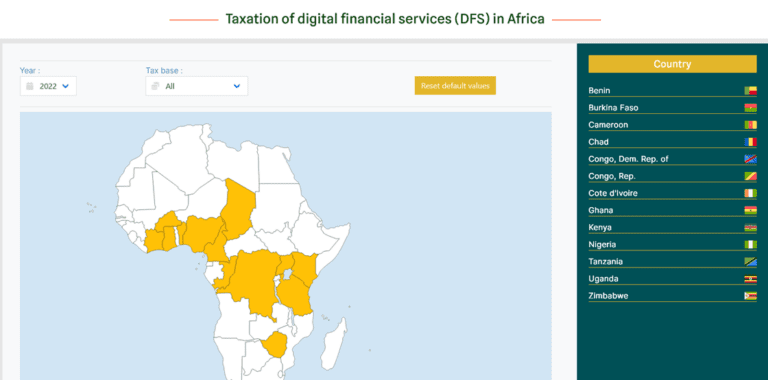
ICTD launches DFS TaxMap: A comprehensive visualisation tool on taxation of digital financial services in Africa
African revenue authority researchers gather to share insights on driving evidence-based tax policy
The ICTD hosted a four-day workshop which brought together a group of partners from the research departments of the tax…
Stakeholder meeting on taxing the informal sector held in Abuja
Nigeria is facing a looming fiscal crisis, with its debt servicing equal to the revenue it generates. More than half…
ICTD researchers discuss taxation of high net worth individuals on TADAT podcast
ICTD Research Director Dr Giulia Mascagni has been featured in a third episode of the TADAT podcast series, sharing the…
Call for research proposals: Taxing the wealthy in lower-income countries
Taxation of wealthy individuals – broadly those with relatively high incomes and/or wealth as compared to national populations – presents…
Virtual
•
Timezone: Europe/London
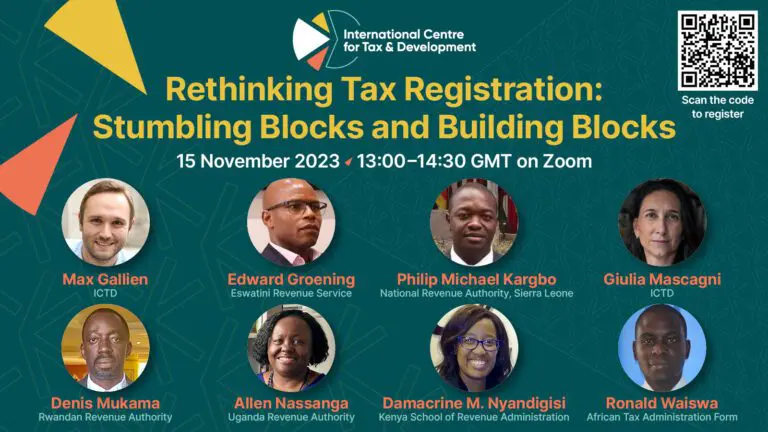
Revenue administrations have recently been investing significant efforts into registering a large number of new taxpayers, in the broader quest to formalise the informal sector. But have these efforts been effective in increasing revenue and improving administration? The ICTD hosted
In person
•
Timezone: Africa/Nairobi
Virtual
•
Timezone: Europe/London
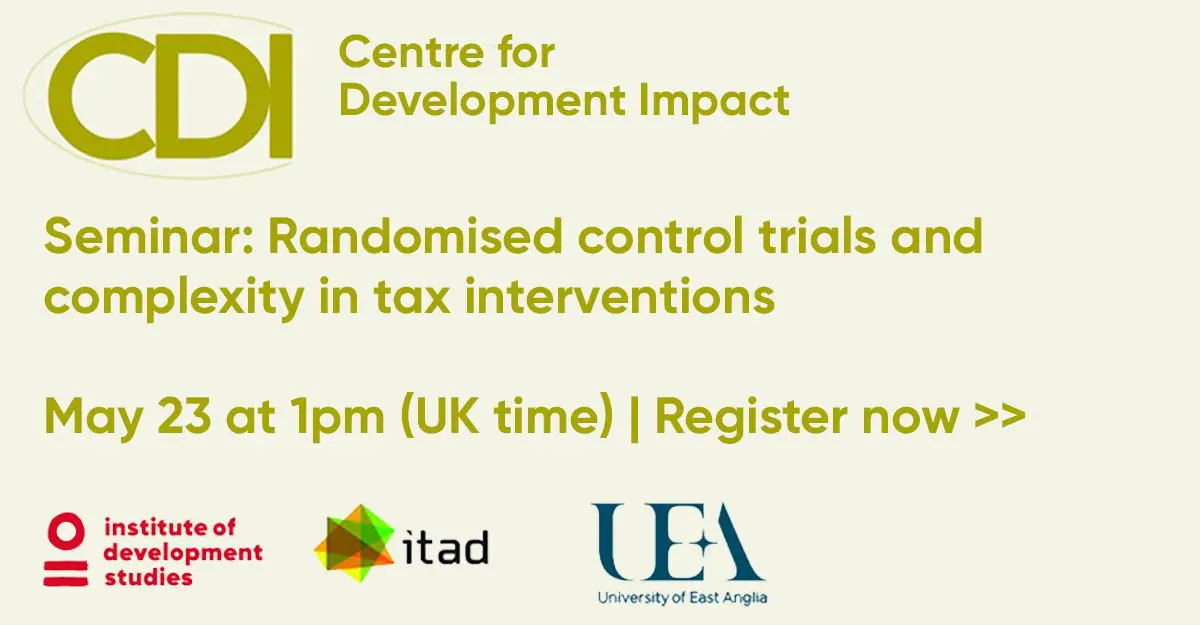
Randomised controlled trials is a method that comes with strengths and weaknesses. Especially in theory-based evaluations of complex programmes, the method is often considered as inappropriate. https://www.youtube.com/watch?v=tDKcykdVs04&ab_channel=InstituteofDevelopmentStudies Giulia Mascagni will reflect on the strengths and weaknesses of the method for

Virtual
•
Timezone: Europe/London
Date: 30th May 2023, 13:30 – 14:30 London time Duration: 60 minutes Language: English only There are three puzzling features of Sub-Saharan African tax systems. First, tax administrations maintain records on vast numbers of small enterprises that actually provide no

Sign up to our Newsletter
Stay up to date with the latest articles, publications, events and more.