




Buy a pack of cigarettes in Pakistan today, and there is a one-in-three chance it carries no valid tax stamp. Even though, since 2021, every legal pack has been built to report its own production to the government in real time. Technology can see the problem. Whether it can fix it is the question.
Industry estimates put the untaxed share above half the market, with revenue losses of up to Rs 343 billion (US$1.2 billion) a year. Tobacco is the worst case, but sugar, cement, and fertilizer have the same problem: a lot of production never shows up in the tax net.
The gap reflects, more than anything, what the tax authority can and cannot see. The Federal Board of Revenue (FBR) has traditionally had to work from whatever firms choose to report — production declarations, invoices, sales filings — and all of these can be doctored before they reach a tax officer. That blindness is expensive.
Pakistan’s tax-to-GDP ratio sits at 10.6 per cent, among the lowest in South Asia and well short of the 13-15 per cent generally considered the minimum for financing basic public services – a predicament shared by half of all developing countries.
The Track and Trace System (TTS), which FBR launched in 2021, is an attempt to fix this: tamper-proof digital stamps that give the authority a live view of production in manufacturing sectors of tobacco, sugar, fertiliser and cement. When it comes to tobacco, notably, the push did not come from the revenue authority alone: formal manufacturers, watching untaxed rivals undercut them, were among the system’s earliest and loudest advocates. Pakistan is hardly alone here.
The WHO Protocol to Eliminate Illicit Trade, which Pakistan ratified in 2018, requires member states to track tobacco products; the EU has run a bloc-wide traceability system since 2019; the industry’s biggest vendor says its platform operates in more than 20 countries; and governments from Kenya to Uganda have extended stamps past tobacco into beer, sugar, and cement.
For the past several months, members of the research team have been embedded inside this system – interviewing the FBR officials who run it and the manufacturers who live with it and walking a factory floor to watch it work. Initial findings suggest that the technology delivers on visibility.
Whether visibility turns into tax compliance, formalisation, and less illicit trade is another matter. Nobody knows – not in Pakistan, and barely anywhere else. That is the question our research project set out to answer.
How Track and Trace Systems makes production visible
TTS is a stamping and production-monitoring system built around what the FBR calls Unique Identification Markings (UIMs). Unlike a manufacturer’s own barcodes, which are independent of TTS and hold static product information that can be reprinted, a UIM has to be digitally activated in FBR’s TransAct platform before it goes on a pack. A licensed vendor consortium generates these machine-readable stamps, and automated applicators fix them to individual consumer packs as they come off the production line.
At a plant the research team visited, the applicator stamped packs at machine speed and discarded any pack with a misapplied stamp.
This happens at an industrial scale: integrated production lines activate stamps automatically as they are applied, while plants without integrated equipment activate them manually in batches through TransAct’s web portal. Every activation is logged as it happens, which gives FBR a running production record to set against each firm’s monthly VAT declarations. And anyone with the public TransAct app — a field officer, a customs inspector, a curious customer — can scan a stamp and check that it is genuine. The graphic below is a visual explanation of that journey from stamp issuance to retail.
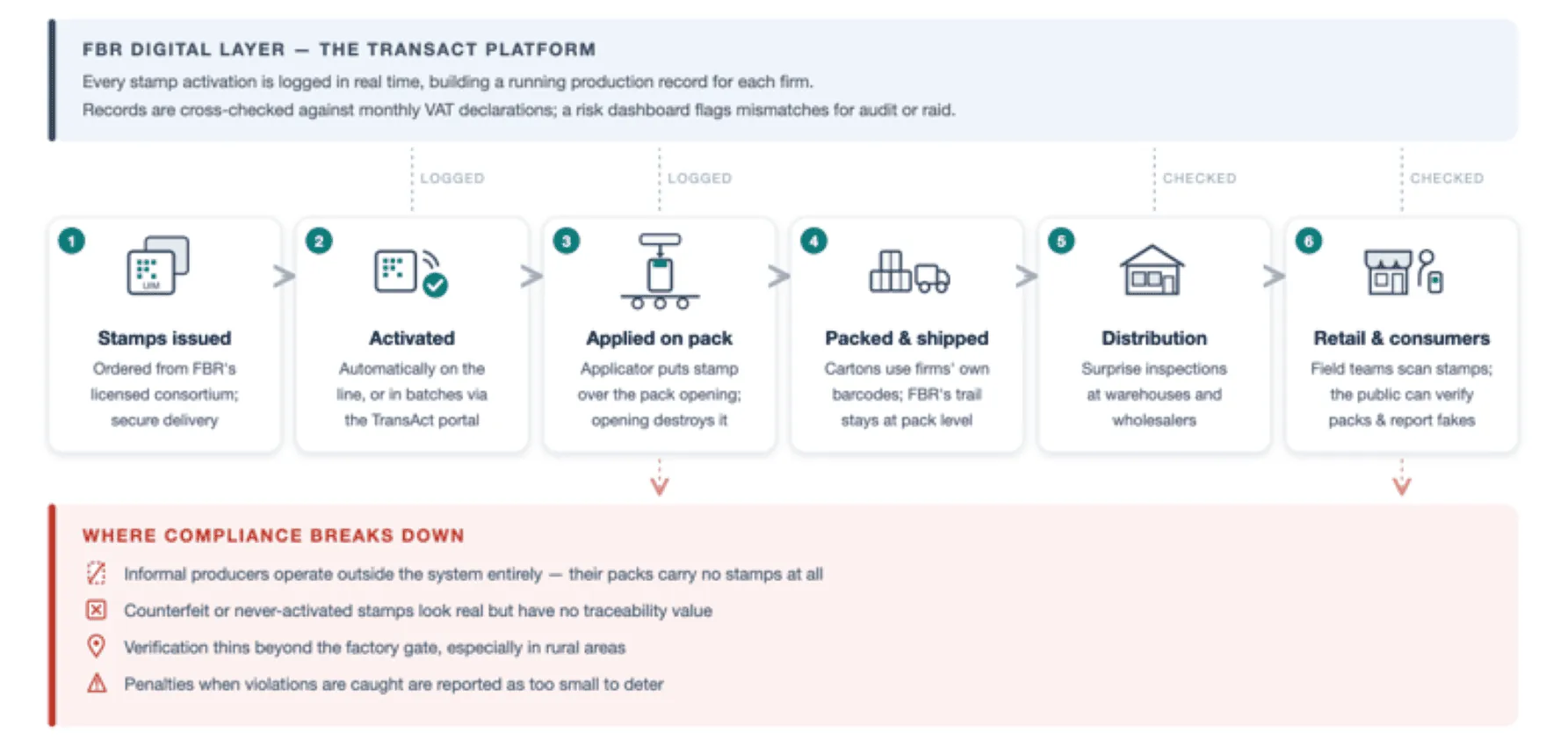
Compiled by authors from FBR technical documentation, key informant interviews, and manufacturing site visits. Credit: Ahsan Zia Farooqi.
The early returns on visibility were striking.
When the system was launched, the revenue authority found it had no record of 55 per cent of the production lines in the sectors it was targeting. However, since its inception, technology has positively impacted revenue collection. FBR reports that in FY 2024-25, collections from sugar and cement rose by more than Rs 52 billion (about US$185 million). Alongside the implementation of production monitoring technology, key informant interviews with enforcement staff suggest that this rise resulted from stricter enforcement across four sectors. What share of that money the system itself deserves credit for — as opposed to rate changes or the wider enforcement drive — is an open question, and one the system’s own data could answer.
The system is still being built out. FBR has begun adding a camera-based counting tool known as the Digital Eye, which tallies units independently of the stamps, and a Hopper system that watches raw-material inputs, so that production can be checked at more than one point in the process. Further down the line is the possibility of connecting TTS to Pakistan’s other digital infrastructure, for example, the Authority’s identity database, the Raast payment rail (Pakistan’s national instant payment system), and FBR’s e-filing platform.
Why implementation of the Digital Tax Stamp has been hard
Reaching this stage, however, has required overcoming successive obstacles: first in developing the system, then in implementing it amid manufacturer opposition and legal challenges. The challenge now is to sustain its operation in an economy where much production is informal and consumers are highly sensitive to prices.
The fight to build it took over a decade (as can be seen from the timeline graphic below).
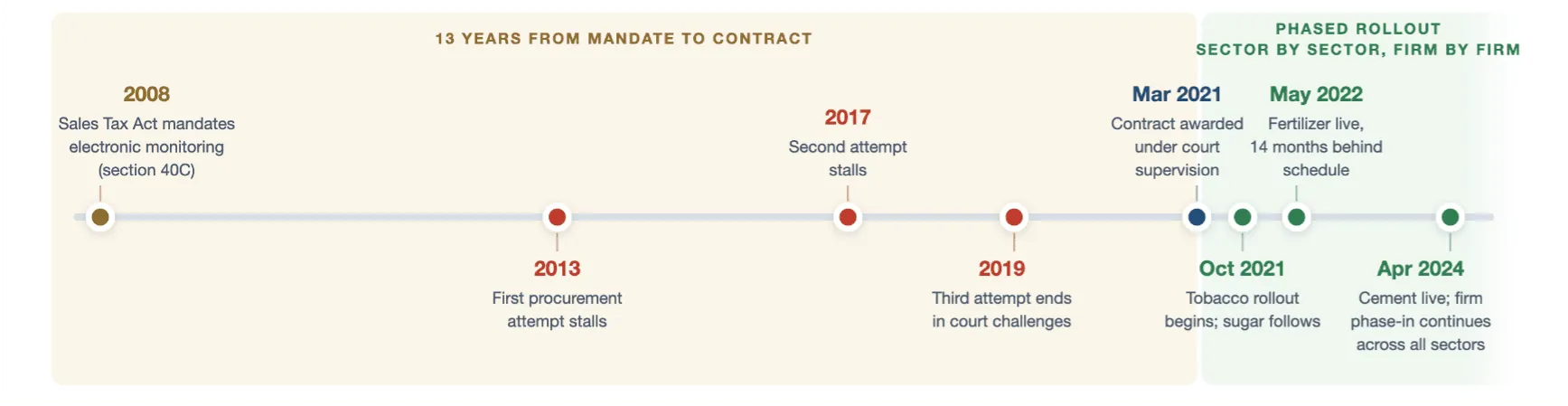
The legal mandate has existed since 2008, but procurement attempts in 2013, 2017, and 2019 all stalled amid competing commercial interests and legal challenges from bidders, which says less about the state’s commitment than about how much money was riding on the contract.
When the award finally went through in March 2021, under court supervision, FBR itself acknowledged the process had taken twelve years.
Even then, officials told us in interviews that capacity limits and resistance from manufacturers forced a staggered rollout, as follows:
- Tobacco and sugar went first, in 2021
- Fertiliser followed in May 2022, already 14 months behind schedule
- Cement took five technical demonstrations and an extension before going live in April 2024
Informal sector and illicit suppliers side-stepping compliance whilst compliant firms shoulder the brunt of the cost
Making it stick is the hardest part.
Pakistan’s informal economy is thought to be worth 35-40 per cent of GDP, and informal producers operate at scale in every sector TTS covers. Price-sensitive consumers keep the pressure on: after the Federal Excise Duty on cigarettes went up 200 percent in August 2022, industry estimates suggest the illicit share of the market climbed from about 20 per cent of sales to more than half within three years.
A registered firm carries compliance costs that its informal rival simply does not, and no monitoring technology fixes that by itself.
Those costs are not trivial.
A manufacturer must install approved applicator equipment, reconcile stamps against production records, and hook its lines into TransAct – a real burden for smaller producers. The most compliant firms end up paying the most, while informal operators pay almost nothing.
One assessment by Oxford Economics, reported in April 2026, concluded that the illicit share of the cigarette market actually grew after TTS arrived. Estimates with industry links tend to overstate illicit trade, and it is hard to say how much of that rise belongs to the 2022 excise shock rather than to the system itself.
From detection to deterrence?
FBR’s answer is enforcement, which runs through two channels:
- A risk dashboard sits on top of the activation data and flags mismatches with VAT declarations.
- Field teams carrying handheld TransAct scanners turn up unannounced at warehouses, wholesalers, and shops; anything that fails the scan can be confiscated, and the case referred onward.
Both channels have grown busier.
FBR’s published crackdown updates record more than 800 raids between June 2023 and December 2025, with nearly 800 million cigarette sticks seized in the tobacco sector alone (see bar graphs below).
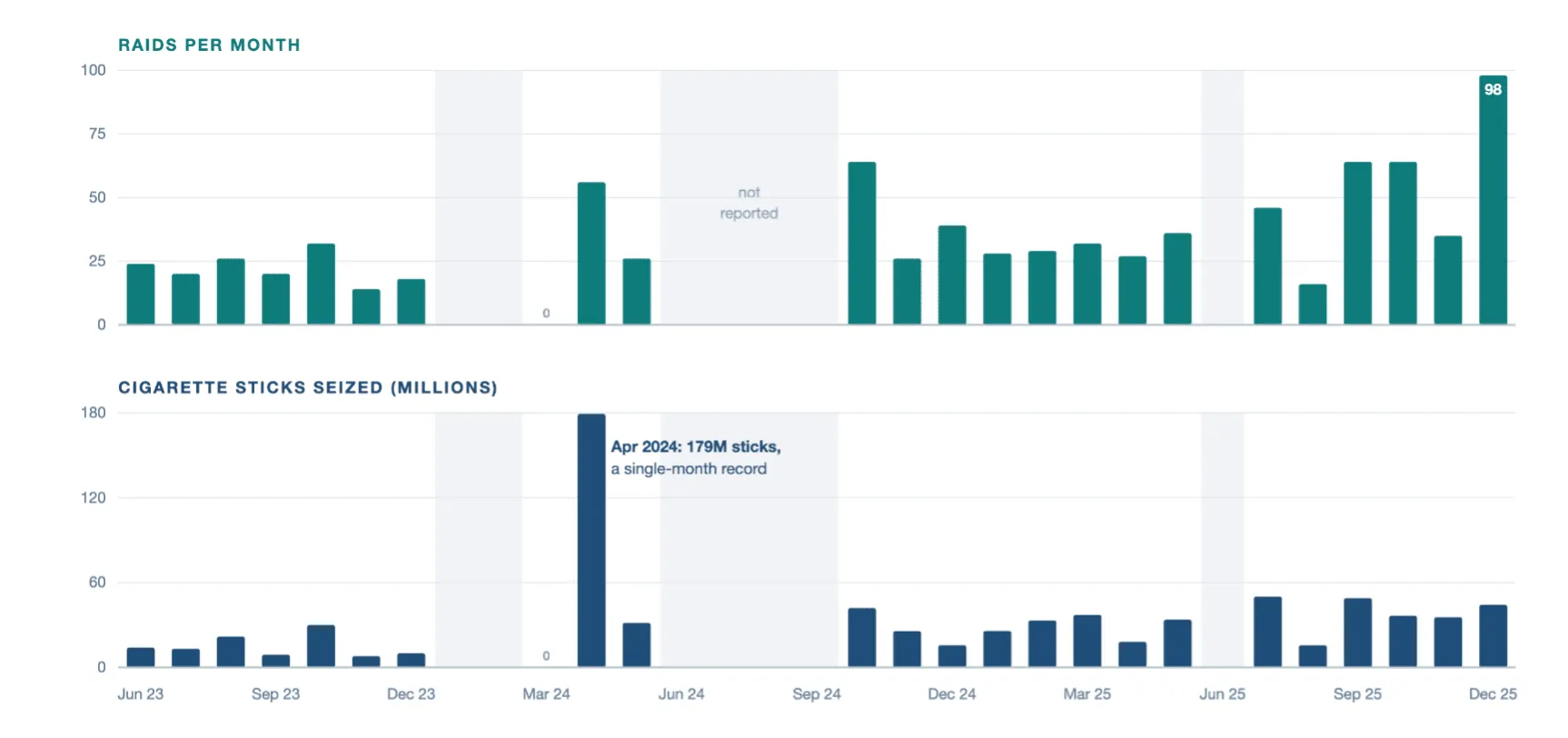
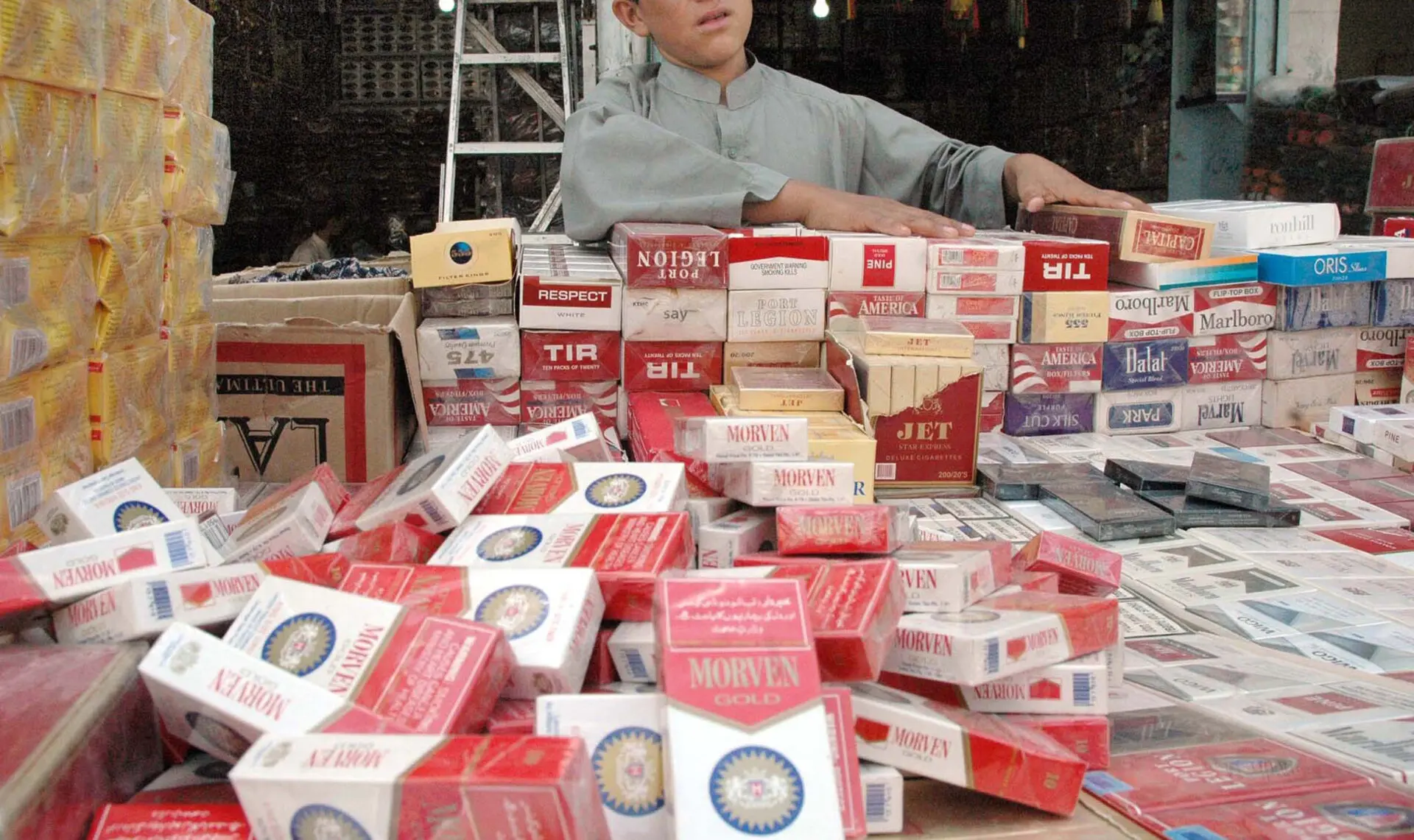
The illicit market has not gone away, though. Stamp coverage in tobacco reached 55 percent of packs in 2023 – 71 percent in cities, 48 percent in rural areas – and by early 2026, only 22 of the 477 cigarette brands on the market were fully compliant. Independent pack surveys show multinationals’ compliance improving sharply between 2023 and 2024, while local manufacturers barely budged. The manufacturers we spoke to described illicit cigarettes on open sale, counterfeit stamps in circulation, and penalties too small to matter.
Are all those raids actually deterring anyone?
The published figures cannot tell us — it is one of the first things a serious evaluation would need to pin down.
What we still need to learn
How much is at stake? The IMF reckons comprehensive tax reform could raise an extra 5 percent of GDP in countries like Pakistan.
But the honest answer about monitoring technology specifically is that very little is known.
A study in Kenya found revenue gains after stamps came in. In Uganda, firms responded to paying for stamps by under-declaring their factory prices by 17 percent, quietly passing the cost back to the government. And Quebec halved its illicit tobacco market with no tracking technology at all – just well-funded, coordinated enforcement.
For Pakistan, almost everything that matters is still unknown.
- Did TTS produce the revenue gains the government reports, or do rate changes and the enforcement drive explain them?
- Is monitoring pulling firms into the formal economy, or quietly pushing smaller producers out as compliance costs bite?
- Are Pakistani firms gaming the system the way Ugandan firms did?
- And, a concern officials in all four sectors raised with us, can the system hold its momentum when governments and priorities change?
Whilst our interviews can describe a system, only its data will tell what it is achieving.
The gap in the evidence is also an opportunity, and Pakistan is unusually well placed to fill it
No study anywhere has isolated the effect of factory-level production monitoring, which is the distinctive part of the TTS design.
Meanwhile, the system is quietly accumulating something few tax authorities possess: granular, real-time production data for entire industries. Put that data in front of a rigorous, independent evaluation, and you could learn where monitoring actually deters evasion, where the leaks are, and which design changes would bring in the most revenue.
Those answers matter well beyond Pakistan, because every country buying this technology is making the same bet. The stamp shows the size of the tax gap. Finding out what closes it is the work ahead.
Research note: This blog draws on Key Informant Interviews conducted between April–May 2026 with FBR senior management, project staff across four sectors, the Directorate of Intelligence & Investigation (Inland Revenue) Lahore, and tobacco, sugar, cement, and fertilizer manufacturers, alongside a structured visit to a major tobacco manufacturing facility in May 2026. It is the first output of a research program led by the Mahbub ul Haq Research Centre at LUMS — in partnership with ICTD, UC San Diego, and IDS, with funding from ICTD — to rigorously evaluate production monitoring in Pakistan. All respondents participated under anonymity; quotations are paraphrased.