Embedding research in tax administration: the value of long-term partnerships
A central pillar of ICTD’s work has been its model of co-produced research. Historically, a lack of robust, relevant data has hindered effective policymaking in lower-income countries, leading to a reliance on evidence drawn from foreign contexts that does not always apply locally.
ICTD’s response has been to build long-term partnerships that enable researchers and practitioners to work together using administrative data – often for the first time. Unlike more traditional one-off approaches, developing self-sustained research capacity requires time, trust, and continuous engagement. Long-term partnerships create the conditions for research insights to be tested, refined, and ultimately embedded within institutional and implementation processes.
Over time, our partnerships have helped transform research units within revenue authorities from being primarily reporting functions, into more strategic actors capable of shaping policy and operations. In countries including Eswatini, Ethiopia, Ghana, Nigeria, Rwanda, Sierra Leone, and Uganda, this model has contributed to both technical and cultural change.
Where research output was once minimal, teams are now producing multiple studies each year, applying data to better understand taxpayer behaviour and improve compliance strategies.
Our partnership with ICTD was game-changing. The Centre’s problem-oriented research produced actionable insights that drove our transformation from an Authority to a Service.
Edward Groening Director of the Research, Strategy and Statistics Department, Eswatini Revenue Service (formerly Eswatini Revenue Authority)
Flagship partnerships: Rwanda and Uganda revenue authorities
The Rwanda Revenue Authority and Uganda Revenue Authority are flagship examples of ICTD’s long-term, embedded partnership model. Over more than a decade of collaboration, ICTD has worked with both institutions to conduct research using administrative tax data, evaluate policy and administrative reforms, and strengthen internal analytical capacity. This collaboration was further deepened in 2019 through a joint capacity-building programme – a year-long pilot of workshops and collaborative research between ICTD researchers and staff from both authorities.
Both the Rwanda Revenue Authority and Uganda Revenue Authority have since emerged as regional leaders in fostering research cultures within tax administration. The Rwanda Revenue Authority’s research division has grown in both size and capability, reflecting a broader institutional commitment to data-driven decision-making. In 2022, it organised its first Research Day to engage key Rwandan stakeholders around the evidence it had produced, including in partnership with independent researchers.
In Uganda, similar progress has been seen through the extensive use of administrative data for research, including the recent establishment of a Secure Research Data Lab, These initiatives help ensure that research findings are produced, disseminated, and applied as part of the administration’s regular learning and decision-making processes.
Previously, there was a lack of analytical research to inform tax administration. ICTD’s engagement filled this gap, promoting evidence-based approaches to tax policy and practice.
Doris Akol Former Commissioner General, Uganda Revenue Authority
Related reading
ICTD’s success has come from a flexible, responsive partnership that adapts to our context and capacity constraints. Their on-the-ground collaboration, not just remote support, has helped address key skills and resource gaps, and consistent leadership has been crucial in building continuity and trust over time.
Denis Mukama Commissioner for Strategy and Risk Analysis Department, Rwanda Revenue Authority

Related experts






Building capacity: the Research on Tax and Development course
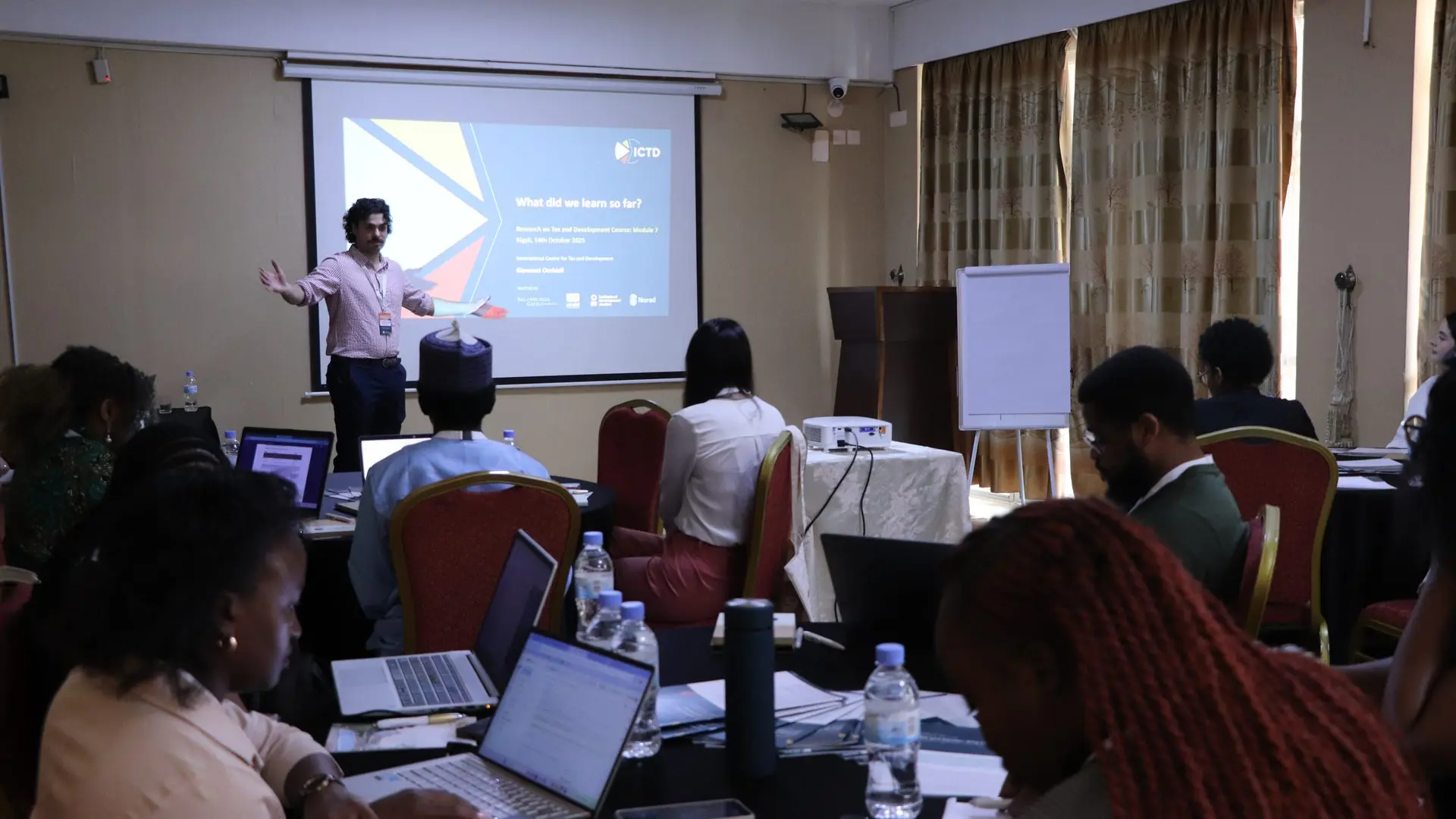
Alongside institutional partnerships, ICTD has invested in strengthening individual capabilities through its flagship Research on Tax and Development course.
Since 2015, the programme has provided a year-long training and mentorship programme to 245 participants from revenue authorities, ministries, and civil society organisations from lower-income countries. What sets the course apart is not only the diversity of its participants, but the depth of engagement it offers. Delivered over a year, the programme combines seven intensive modules covering qualitative and quantitative research methods, data analysis, and the communication of evidence to policy audiences.
To maximise peer learning, it concludes with an in-person module where each participant presents a research project they have developed over the duration of the programme, and receives feedback from peers and course facilitators.
The course is built around close mentorship, with ICTD researchers working directly with participants to develop research questions, strengthen analytical skills, and translate ideas into policy-relevant outputs.
Demand for the course reflects a growing recognition of the importance of research skills within tax systems. Over 550 applicants expressed interest in joining the 2025/26 cohort.
A defining feature of ICTD’s approach is the emphasis on mentorship, and continued engagement beyond formal training. This has helped many alumni translate learning into concrete action within their organisations and countries. In a recent survey of course alumni, approximately 70% of respondents reported increased involvement in research activities in their daily jobs since completing the course.
In Somalia, Najibullah Nor Isak progressed from a junior officer to Director of the Customs Department at the Ministry of Finance, applying research skills to develop a Medium-Term Revenue Roadmap and establish a Research and Analytical Unit. These efforts contributed to a significant increase in domestic revenue, supporting broader goals of fiscal independence.
Do not simply tell your managers that research is important. Show them how it can inform decisions.
Najibullah Nor Isak Research on Tax and Development alumnus (2021/22)
In Nigeria, Rafat Gambo played a central role in a major legislative reform process, serving as Secretariat Lead for a task force that contributed to the development of four landmark tax laws adopted in 2025.
The course gave me the analytical tools and policy lens to contribute meaningfully to national reform.
Rafat Gambo Research on Tax and Development alumnus (2019/21)
Other alumni are contributing to generating evidence in new and emerging areas: from fisheries taxation in Kenya, to understanding the constraints faced by tax collectors in Malawi. These contributions demonstrate how investments in people can have ripple effects across both policy and research communities.
Related reading
- From agriculture to tax: how an ICTD course changed one man’s career
- From tax officer to customs director: an ICTD alum driving reform
- Nigeria’s historic tax reform led by ICTD tax course alumnus
- From Venezuela to Portugal: an ICTD alum bridging research and tax reform across continents
- How ICTD’s Research on Tax and Development course reignited a PhD ambition
The course opened for me the world of taxation and development. I can credit it for changing my perspective and research career.
Seid Yimam Research on Tax and Development alumnus (2018/19)
Related experts

Supporting the next generation of tax researchers: doctoral fellowships
ICTD has also invested in doctoral training to support emerging research leaders from diverse backgrounds. Fully-funded PhD scholarships enable practitioners and researchers to pursue in-depth study on pressing tax policy issues, often with direct relevance to their home countries. Interest in these opportunities has been strong, with more than 240 applications received for 4 positions in 2023.
As of 2025, 12 PhD students had been supported through ICTD’s doctoral programme, representing a large cohort of emerging researchers from Africa, Asia, and Europe. While bringing a wide range of disciplinary and regional perspectives, their research remains deeply rooted in the policy realities of lower-income countries – often drawing directly on the contexts in which they live and work. Early outcomes from the programme already illustrate its potential impact. In Uganda, Adrienne Lees’ work on compliance costs has highlighted the disproportionate burden faced by small firms, informing ongoing policy discussions.
Other students are exploring issues such as gender and taxation, and the role of digitalisation in state-building – areas that are increasingly central to global debates.
Sripriya Srivatsa’s research challenges the assumption of a uniform taxpayer experience. Drawing on evidence from six African countries, she shows how gendered norms, particularly around care responsibilities and access to economic opportunities, shape how women engage with tax systems.
Working with ICTD provided both the resources and the support network to take my research further: fieldwork funding across multiple countries, access to invaluable insights and collaborations with revenue authorities, and an exceptional team that helped translate the work beyond academia into wider policy and public audiences.
Sripriya Srivatsa Former PhD student
Related reading
The collaborative environment and mentorship offered by ICTD pushed me to think carefully about how research interacts with policy and look at impact, not just outputs.
Adrienne Lees Former PhD student
Related experts